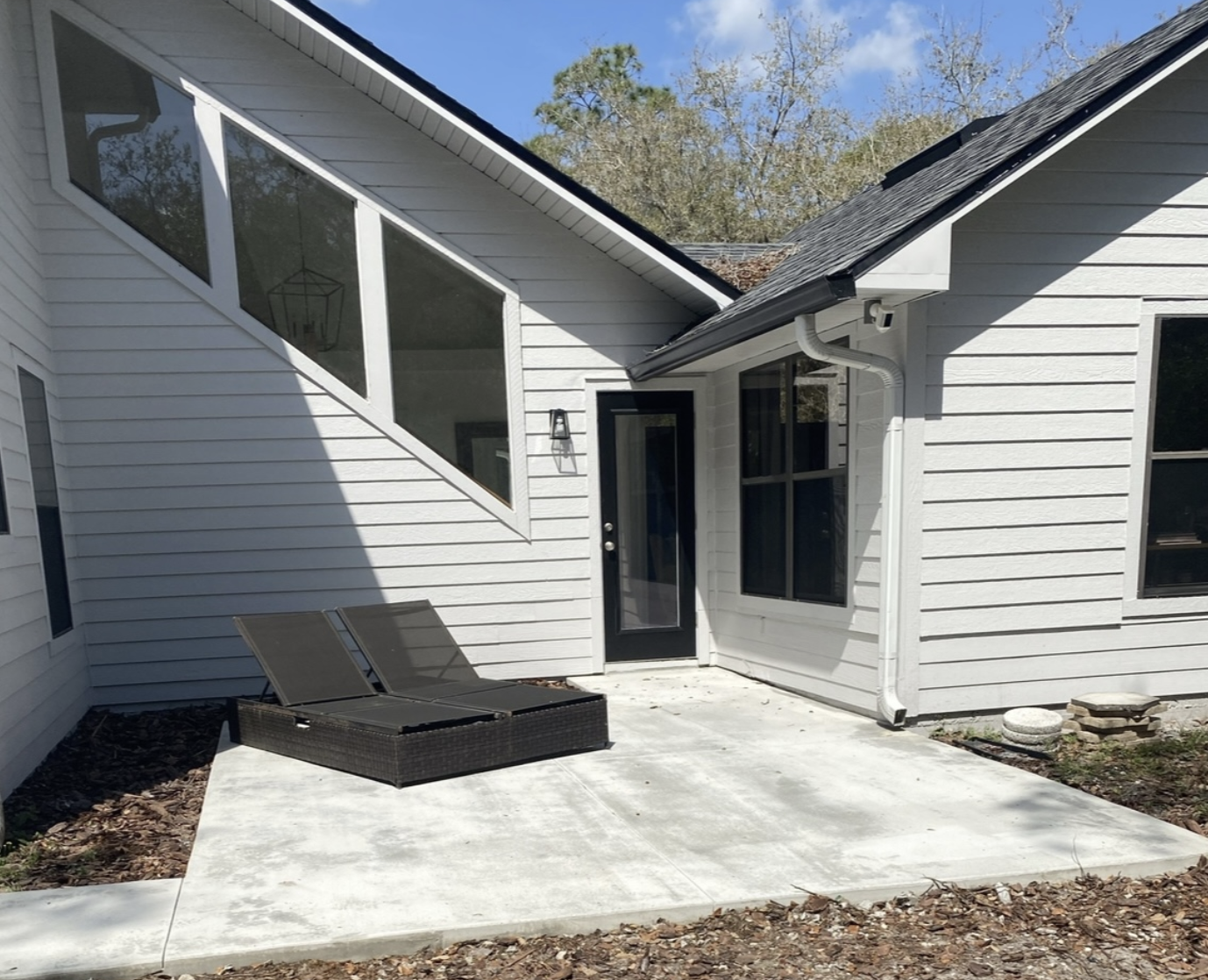
Walk out to your backyard right now and take a hard look at your concrete patio. Not a glance — a real, honest look. Is the surface still holding its color, or has it faded into a chalky, washed-out version of what it once was? Are there greenish patches creeping along the edges? Dark streaks cutting across the center? Uneven spots where the finish has started to lift or flake? If any of that sounds familiar, your patio is not just aging — it is actively working against your home’s appearance, your property’s value, and in some cases, the safety of everyone who uses it.
Homeowners tend to treat concrete patios as background — functional surfaces that exist to hold furniture and handle foot traffic. But buyers, neighbors, and anyone who spends real time assessing a property see that patio differently. They see what it signals. A clean, sealed, well-maintained patio communicates that this home has been cared for. A faded, stained, mildew-covered slab communicates the opposite — and that message travels fast, carries weight, and costs real money when it matters most.
Sun Damage Isn’t Subtle in Central Florida
Central Florida does not give a concrete break. The climate here is genuinely hostile to outdoor surfaces — not in an obvious, dramatic way, but in a slow, relentless way that compounds season after season until the damage becomes impossible to ignore. Sits in one of the highest UV exposure zones in the entire country, and that UV exposure is the primary driver behind why concrete patios in this region fade, chalk, and deteriorate far faster than homeowners expect.
UV Exposure Breaks Down Concrete Over Time
When a concrete patio is first installed or restored, it typically gets sealed. That sealer creates a protective barrier between the raw concrete and everything the environment throws at it — sun, rain, foot traffic, and temperature swings. But UV damage to concrete is cumulative. Every season, those UV rays break down the sealer’s molecular structure, degrade the pigments in any applied stain, and weaken the bond between the coating and the surface beneath it.
Rain and Humidity Due to an Unprotected Slab
UV exposure opens the door, and Florida’s rain and humidity walk right through it. Water infiltration in concrete is one of the most destructive forces a patio can face in this climate, and once the sealer is compromised, that infiltration begins immediately. Every rainstorm drives moisture deeper into the porous surface. Every dry period pulls it back out, expanding and contracting the material in cycles that create micro-cracks invisible to the naked eye — until they are not.
Algae discoloration of concrete typically presents as that greenish-black tint that spreads from shaded corners outward, covering more of the surface each season. Mold and mildew grow into the surface texture, not just on top of it, which is why a quick spray with a garden hose does nothing to address the problem.
Patios Age Faster Than Patios in Other States
Homeowners who move to from the Midwest or the Northeast are often shocked at how quickly their outdoor concrete deteriorates compared to what they experienced up north. The reason is compounding stress. In colder climates, concrete faces freeze-thaw damage in winter but gets a genuine rest period where UV and biological growth are minimal. The assault is year-round. High UV in summer. Heavy rain from May through October. Warm, humid conditions that sustain biological growth through what passes for winter.
Buyers Notice What You’ve Stopped Seeing
You have walked past your patio so many times that you have stopped really seeing it. The fading became the new normal. The staining blended into the background. The worn patches stopped registering as problems and started registering as just the way the patio looks. This is a completely natural psychological response to gradual environmental change — but it is also a financial liability when it comes time to sell or even just maintain your home’s standing in the neighborhood.
The Perception Problem That Faded Concrete Creates
A buyer walking through your home for the first time has none of that adaptation. They are seeing your property with completely fresh eyes, and what they see when they step out onto a faded, stained, deteriorating patio is not a surface that needs some cleaning. They see patio deferred maintenance — a phrase that carries serious weight in real estate because it implies a pattern, not an isolated oversight.
A single deteriorating surface becomes a question mark over the entire home, and question marks cost money at closing. Real estate outdoor spaces are one of the top factors buyers weigh in Florida, and a patio in rough shape gives them a legitimate, visible reason to push for a lower price or walk away entirely.
Real Estate Agents Say About Outdoor Spaces in Florida
Florida outdoor living lifestyle is not a marketing slogan — it is a genuine behavioral reality that shapes how buyers evaluate homes in this market. People move to expecting to use their outdoor spaces. A covered patio, a pool deck, a screened lanai — these are not nice-to-have extras in Florida real estate. They are expected features that buyers factor into their decision-making from the moment they pull up to the property.
What Fading Actually Costs You
Most homeowners file faded concrete under cosmetic concerns and move it down the priority list indefinitely. That is a mistake. The cost of a deteriorating patio is not a future expense — it is a current one, accruing right now in the form of lost property value, increased safety risk, and a repair scope that grows more expensive every season you wait.
The Direct Impact on Property Value
Property value boost is one of the clearest returns on any outdoor renovation or restoration investment, and patio home value is a well-documented component of that. Homes with clean, maintained outdoor concrete consistently appraise higher and sell faster than comparable homes with neglected surfaces. The inverse is equally true — a faded, stained, deteriorating patio actively suppresses perceived value and gives appraisers, buyers, and agents a data point that works against your number.
Safety Hazards That Develop as Concrete Deteriorates
Slip hazard prevention patio maintenance is not an abstract concern in Florida’s climate. As concrete sealer UV protection fails and the surface texture breaks down, smooth sections become rough and rough sections become slick. Mold and mildew create a film on the surface that, when wet, functions almost like ice. Frequent rain events leave that film activated on a regular basis, and anyone who steps onto that surface without realizing the hazard is at genuine risk.
Restoration Brings It Back Without Starting Over
Here is the reality that most homeowners do not know until they talk to a professional: the vast majority of faded, stained, and deteriorating concrete patios do not need to be demolished and replaced. Concrete patio restoration, done correctly with the right materials and proper surface preparation, can completely transform the appearance and performance of an existing slab — and it costs a fraction of full replacement.
Professional Concrete Restoration Actually Involves
The restoration process begins with assessment. A professional concrete contractor evaluates the condition of the slab — checking for structural integrity, identifying the depth of staining, assessing drainage patterns, and determining which restoration approach will produce the best long-term result.
This step matters because not all faded patios have the same underlying condition, and the right approach for a surface with minor UV fading is different from the right approach for a surface with spalling, cracking, or deep moisture damage.
Decorative Finish Options That Outperform Plain Concrete
One of the advantages of professional concrete patio restoration is the opportunity to upgrade the surface at the same time you are repairing it. Decorative concrete finishes have become extremely popular and for good reason — they offer visual options far beyond what plain gray concrete provides while also delivering better durability and UV resistance than unfinished slabs.
Stamped concrete installations replicate the look of natural stone, brick, tile, and wood with impressive realism. The pattern is pressed into the overlay or resurfacing material before it sets, creating texture and visual depth that is genuinely attractive rather than industrial.
Why Sealing Is the Step You Cannot Skip
Every concrete restoration — regardless of which surface treatment is used — must end with proper sealing. Concrete sealer UV protection is what makes the entire investment last. Without it, even a beautifully restored surface begins degrading immediately, subject to the same UV breakdown, moisture infiltration, and biological growth that damaged it in the first place.
Not all sealers are appropriate for climate. Consumer-grade products available at hardware stores are often formulated for moderate conditions and fail quickly under Central Florida’s combination of intense UV, high heat, and persistent humidity.
Common Mistakes That Make It Worse
A faded concrete patio is already a problem — but the wrong response to that problem can turn a manageable repair into a costly disaster. Homeowners across make the same mistakes repeatedly when they try to address deteriorating outdoor concrete on their own or hire the wrong contractor for the job.
These are not minor errors in judgment. They are the kind of mistakes that lock in damage, waste hundreds of dollars, and sometimes force a complete redo that costs more than a professional restoration would have from the start.
- Skipping surface preparation entirely. Applying stain, sealer, or overlay material to a surface that has not been thoroughly cleaned, chemically etched, and completely dried guarantees adhesion failure — the product bonds to the dirt, mildew, and failed coating rather than to the concrete itself. No product, regardless of how premium or expensive it is, can compensate for improper surface prep, and the result is always a finish that peels, bubbles, or lifts within one season.
- Using products not formulated for Florida’s climate. Consumer-grade sealers and stains sold at big-box stores are often engineered for moderate climates, not for the combination of extreme UV exposure, high ambient temperatures, and year-round humidity that Central Florida patios face every single day. These products may look acceptable for the first few months, then begin clouding, chalking, or peeling as soon as they face their first full Florida summer — and fixing a failed sealer application is often more work than the original restoration.
- Ignoring drainage problems before restoring the surface. If your patio is graded incorrectly or surrounded by landscaping that channels water toward the slab rather than away from it, no surface restoration will produce lasting results regardless of how well the work is executed. Water infiltration in concrete will continue pooling after every rainstorm, biological growth will return within one rainy season, and the surface will deteriorate on exactly the same timeline as before.
- Waiting until the concrete is cracking or spalling before acting. A surface that qualifies for straightforward cleaning, staining, and sealing at the cosmetic-fading stage may require concrete crack repair, deep grinding, or full concrete overlay resurfacing by the time structural deterioration has set in. Concrete spalling repair is significantly more involved and costly than basic restoration — and every season a homeowner delays, the scope and price of the necessary fix continues to expand.
- Applying new sealer over old, failed coating. A new coat of sealer cannot bond properly through a compromised layer that has already begun to fail — instead, both layers eventually peel together, often pulling surface material with them and leaving the concrete in worse condition than before. The failed coating must be fully stripped through pressure washing, chemical stripping, or mechanical grinding before any new product is applied, and there are absolutely no shortcuts around this step.
- Choosing the wrong contractor based on price alone. Not all concrete contractors have hands-on experience with decorative concrete finishes, concrete overlay resurfacing, or the specific product knowledge required to deliver lasting results in Orlando’s demanding climate. Hiring based on the lowest bid without verifying real experience with concrete staining, textured concrete overlays, and proper sealing technique is a fast path to a result that fails quickly and leaves your patio looking worse than the original problem did.
What a Fresh Patio Does for Your Property
Your patio is one of the first outdoor spaces a buyer, neighbor, or guest actually spends time in — and the condition of that surface shapes their entire perception of your property within seconds of stepping onto it. A fresh, restored concrete patio does not just look better.
It communicates something fundamental about how this home has been maintained, how much pride the owner takes in the property, and whether this is a home worth investing in. That communication happens instantly, wordlessly, and with a level of impact that most homeowners significantly underestimate until they experience the difference firsthand.
Instant Curb Appeal That Sets Your Home Apart
A clean, sealed, freshly restored patio immediately elevates your home’s exterior presentation in a way that few other investments can match at the same price point. Curb appeal improvement is one of the highest-return investments a homeowner can make, and concrete restoration delivers that return faster and more visibly than almost any other exterior upgrade. When your patio looks sharp, the entire backyard looks intentional — and that intentionality signals quality to everyone who sees it.
Why Outdoor Spaces Matter More Here
Florida is not like other states when it comes to how outdoor spaces factor into home value, lifestyle expectations, and buying decisions. In colder climates, a backyard patio is a seasonal amenity — something used for a few months and then forgotten until spring. Outdoor space is a year-round living environment that buyers factor into their purchasing decisions with the same weight they give to square footage, kitchen quality, and school districts.
Understanding why outdoor spaces carry such disproportionate importance in this market is essential to understanding why your patio’s condition matters as much as it does.
Florida Living Happens Outside Year-Round
Unlike most of the country, Central Florida’s climate makes genuine outdoor living possible twelve months a year. That reality shapes buyer expectations fundamentally — outdoor spaces are not a bonus feature in this market, they are a baseline expectation that every serious listing needs to meet.
Buyers moving from northern states are often specifically motivated by the prospect of year-round outdoor living, and they are evaluating patios, lanais, and pool decks with that motivation firmly in mind.
HOA Standards and Neighborhood Expectations
HOA exterior maintenance requirements are not arbitrary bureaucratic standards — they exist because deteriorating surfaces on individual properties visibly affect the appeal and perceived value of the entire neighborhood. Many communities have specific guidelines around outdoor surface maintenance, and a faded, stained patio that falls below those standards can result in formal notices, fines, and required repairs on a timeline that is not of your choosing.
The ROI of a Restored Patio
Home improvement ROI is the lens through which every renovation decision should ultimately be evaluated — not just the upfront cost, but the full return on that investment in terms of property value, avoided future expenses, lifestyle improvement, and the financial outcome when you eventually sell. When you apply that lens to concrete patio restoration, the numbers tell a clear and compelling story. Professional restoration is not an expense. It is one of the most cost-effective investments a homeowner can make in their property’s long-term value and performance.
The return on concrete restoration shows up in multiple places simultaneously — in stronger buyer offers, in avoided escalating repair costs, in the safety liability you eliminate, and in the quality of life you recover when your outdoor space actually functions as the living environment it was designed to be. Understanding the full scope of that return helps clarify why delaying restoration is not a neutral financial decision. It is a decision that costs you money in ways that are easy to underestimate until you see them clearly laid out.
Your Patio Reflects How You Treat the Whole Property
There is a principle in property maintenance that experienced real estate agents, appraisers, and buyers all understand intuitively — the visible surfaces of a home tell you how the invisible systems have been treated. When buyers see a well-maintained patio, they extend that care to their mental model of the entire property.
When they see a neglected one, they do the same in the opposite direction. Your patio is not an isolated surface. It is a reflection of your maintenance philosophy, and that reflection shapes how everyone who encounters your property evaluates everything else about it.
Buyers Read Into a Neglected Outdoor Surface
When a buyer steps onto a faded, stained, mildew-covered patio during a home tour, the thought process that follows is immediate and instinctive. If this surface has been neglected, what else has been neglected? That question does not stay in the backyard — it follows the buyer through every room of the house, making them more attuned to minor imperfections, more skeptical of claimed maintenance histories, and more aggressive in their negotiations.
The Signal Your Home Sends Every Single Day
Your patio is visible not just during home tours but every single day — to neighbors walking past, to delivery drivers pulling into the driveway, to family members and guests arriving for gatherings. Every day that faded concrete sits unaddressed, it is sending a signal about how this property is maintained.
That signal shapes neighborhood perception, influences how your home compares to others on the street, and contributes to the cumulative impression that either adds to or subtracts from your property’s standing in the community.
Let’s Restore Your Patio’s Appeal Together
If you have read this far, you already know the truth about your patio — and you know that the longer it sits in its current condition, the more it costs you in value, safety, and the impression your property makes every single day. The question is not whether your patio needs attention. The question is how quickly you want to stop letting it work against you and start letting it work for you. Professional concrete patio restoration is the answer, and it is more accessible, more affordable, and more impactful than most homeowners realize until they see the result for themselves.
At Concrete Solutions of Central Florida, we have spent years restoring faded, stained, and deteriorating concrete patios across the area — and we understand exactly what this climate demands from outdoor surfaces and from the professionals who work on them. We know which products hold up in Central Florida’s heat and humidity. We know how to assess a compromised surface and identify the right restoration approach for its specific condition.
Conclusion
A faded concrete patio in Orlando is not just an eyesore — it is a direct hit to your property value, your safety, and your home’s overall impression. Every season you wait, the damage compounds, the repair cost grows, and the signal your patio sends gets worse. Professional concrete patio restoration fixes all of that at a fraction of replacement cost, and the return shows up immediately in curb appeal, buyer perception, and daily quality of life. The right time to act is before the damage gets deeper — and that time is right now.
Your outdoor space should be working for your property, not against it. A restored, sealed, visually sharp patio tells buyers, neighbors, and appraisers that this home has been maintained with care. It removes the question marks that deferred maintenance creates and replaces them with confidence.
Frequently Asked Questions
Q1. How long does a professional concrete patio restoration last?
A professionally restored patio in typically lasts 5 to 10 years with proper maintenance. Resealing every 2 to 3 years extends that lifespan significantly. Using products rated for Florida’s climate is the key factor in long-term durability.
Q2. Will restoring my patio increase my home’s resale value?
Yes. A clean, sealed patio directly supports your asking price and removes a buyer’s negotiating point. In Florida’s market, outdoor spaces carry serious weight in buying decisions and property appraisals.
Q3. What is the difference between concrete resurfacing and full replacement?
Resurfacing applies a fresh overlay over your existing structurally sound slab — faster, cheaper, and less disruptive than full replacement. Most faded patios qualify for resurfacing rather than demolition and repour.
Q4. How do I know if my patio needs restoration or just cleaning?
Surface dullness and minor staining usually respond well to professional cleaning and resealing. Visible cracking, spalling, or deep moisture damage means restoration is needed. A professional assessment gives you the clearest and most accurate answer.
Q5. How often should I reseal my concrete patio in Central Florida?
Every 2 to 3 years is the general recommendation for climate. Watch for water absorbing into the surface instead of beading up — that is the clearest sign resealing is overdue. Staying proactive with sealing is always more affordable than repairing damage from a failed surface.
Professional Concrete Services in Orlando, FL
Accu-Krete provides reliable concrete installation, repair, decorative concrete, patios, driveways, and sidewalk solutions for homeowners and businesses across Orlando and nearby areas.