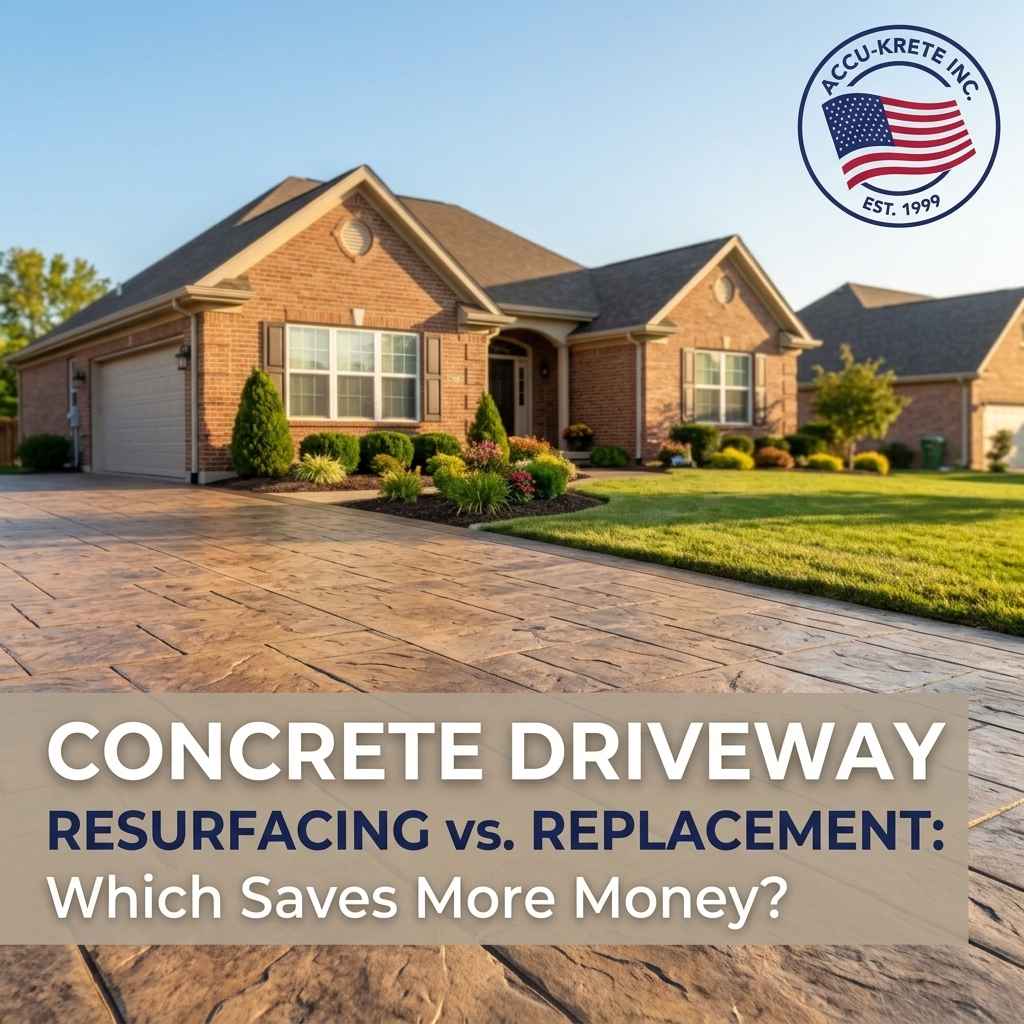
Dealing with a cracked, worn-out driveway is incredibly frustrating, especially when it damages your home’s curb appeal and pulls down its value. If you are looking at surface scaling, ugly discoloration, or deep cracks, you need to figure out whether a surface fix will do the job or if it is time to tear the whole thing out. Choosing between concrete driveway resurfacing vs replacement comes down to an honest assessment of what is going on underneath the surface so you do not throw away thousands of dollars on a temporary solution.
The truth is, covering up a major structural failure with a cosmetic touch-up is a waste of money because it leads directly to early cracking and repeated repair bills. This guide breaks down the real differences between fixing up your existing driveway surface and completely tearing it down for a fresh start. By understanding how each process works, you can choose the most cost-effective option that actually holds up and protects your property over the long term.
What Is Concrete Driveway Resurfacing?
Concrete driveway resurfacing is an excellent, budget-friendly way to make your driveway look brand new without paying for a full demolition. Instead of breaking up the entire slab, concrete specialists clean the existing surface, patch up minor surface cracking, and apply a premium polymer-modified concrete overlay. This fresh top layer completely covers shallow pits, scaling, and minor imperfections, leaving you with a smooth, clean finish that looks just like a brand-new pour.
This chemical bond stops the new top layer from peeling, flaking, or lifting off the original slab over time. Contractors also use specialized leveling compounds to smooth out low spots, which keeps the surface perfectly flat and prevents water from collecting when it rains.
Material Limitations
While resurfacing works great as a cosmetic upgrade, it cannot fix deep structural problems. It is perfect for extending the life of a driveway that only has surface-level wear, but it will not save a slab that is fundamentally broken.
If your driveway has major foundation faults, a fresh overlay will only hide the damage for a short while before the old cracks push through again. Checking your slab integrity beforehand is essential if you want to avoid failure during winter freezes and summer heatwaves.
What Is Concrete Driveway Replacement?
Concrete driveway replacement is a complete, ground-up reconstruction that involves tearing out and hauling away every single piece of your old pavement. You absolutely need to go this route if an inspection reveals deep structural damage, extensive pitting, or severe slab instability.
Once a driveway reaches a certain level of decay, surface repairs become completely useless, leaving total demolition as your only real option for a safe, solid surface.
Base Support
The entire process starts with heavy machinery breaking up the old concrete, followed by a thorough check of the subgrade to fix any poor base support. True durability depends entirely on base stability, meaning any shifting soil, hollow spots, or erosion must be packed down and corrected before any new concrete is poured. Contractors also use this time to deal with external threats like aggressive tree roots and poor water drainage patterns that could ruin the new slab.
Structural Reinforcement
After stabilizing the soil foundation, concrete specialists build a strong internal grid using embedded steel mesh or fiber-reinforced concrete. This internal skeleton gives the driveway serious load-bearing strength, allowing it to handle heavy vehicles without breaking under pressure.
Starting fresh also allows you to correct the slope of your driveway for proper water runoff while using modern, high-grade concrete mixes. This advanced structural reinforcement keeps cracks from developing when the driveway is put under extreme weight and daily use.
Key Differences Concrete Driveway: Resurfacing vs Replacement
When you are weighing resurfacing against replacing concrete, you have to balance your current budget against how long you want the solution to last. The ultimate deciding factor should always be the structural integrity of the slab and the health of the ground underneath.
Cosmetic upgrades work well for everyday surface wear, but deeper foundation problems mean you need a full tear-out and replacement.
Cost Differences
The overall cost difference between these two methods is usually the biggest factor for most homeowners. Resurfacing is very affordable because it requires less labor and fewer raw materials, making it a great budget option for fixing minor surface issues.
A full replacement, on the other hand, requires heavy machinery, dump trucks for debris removal, and large volumes of new material, which naturally comes with a higher price tag. While the upfront cost is greater, a replacement saves you money in the long run by ending the endless cycle of patching up a failing driveway.
Slab Integrity
Pouring a fresh surface overlay on top of a sinking, unstable base is practically guaranteed to cause rapid reflective cracking, which means you end up paying for a full replacement anyway. If the ground beneath your driveway is actively washing away or being pushed up by tree roots, resurfacing will fail very quickly.
Checking the structural health of the concrete ensures you do not waste money covering up major foundation faults that need deep ground correction. Taking the time to properly diagnose subgrade failures helps you avoid watching a brand-new cosmetic layer fall apart within a single year.
Professional Inspection
Bringing in qualified concrete specialists is the best way to get an honest, accurate picture of your driveway’s actual condition. Experienced professionals can tell the difference between minor surface imperfections and dangerous foundation issues that threaten your home’s value.
Their technical knowledge saves you money in the long run by making sure you choose the right repair path for your specific situation and budget.
How to Read Your Driveway: Signs That Tell You What It Needs
Your driveway constantly shows clues about what is happening beneath the surface, and learning to read these signs protects you from making an expensive mistake. Homeowners need to carefully look at the pattern, depth, and spread of damage before investing in any materials or hiring contractors. Superficial blemishes need a completely different approach than deep structural failures, and guessing wrong means wasting money.
- Minor Surface Cracking: Tiny hairline fissures that only affect the very top layer mean your slab integrity is still perfectly fine.
- Shallow Pitting and Scaling: Small pop-outs, surface flaking, or cosmetic blemishes caused by general weather wear do not threaten the foundation.
- Deep Interconnected Fractures: Large cracks running all the way through the slab indicate that your driveway is failing from within and needs serious attention.
- Sinking and Unlevel Slabs: Sections of concrete dropping or shifting point directly to severe foundation problems and subgrade failure underneath.
Concrete Driveway Resurfacing vs Replacement: What Is the Cost Difference?
The upfront cost difference between these two projects is a major financial consideration for most homeowners. Resurfacing is very affordable because it uses less labor and fewer raw materials, making it a practical budget option for fixing minor surface issues. A full replacement, however, requires heavy demolition machinery, significant debris disposal costs, large volumes of material, and extensive ground preparation, all of which come with a higher price tag.
To help you understand the financial and logistical differences, here is a detailed breakdown of how both options compare across key categories:
| Cost & Project Factors | Concrete Driveway Resurfacing | Concrete Driveway Replacement |
| Upfront Cost Profile | Lower initial cost; budget-friendly option. | Higher upfront cost; premium long-term investment. |
| Primary Materials Needed | Bonding agent, leveling compounds, polymer overlay. | Steel mesh, fibre-reinforced concrete, new aggregate base. |
| Labor & Machinery Required | Low; basic surface cleaning and overlay application. | High; heavy demolition machinery and debris haul-away. |
| Project Lifespan | Extends driveway life by 8 to 15 years with basic upkeep. | Provides a brand-new lifespan of 30 to 40+ years. |
| Long-Term Financial Value | Great short-term savings for structurally sound slabs. | High long-term value; completely ends the repair cycle. |
Factors That Affect the Right Choice for Your Driveway
Selecting the right repair method requires looking past the surface to understand how environmental forces and age affect your driveway. Property owners often focus entirely on the price, ignoring the physical factors that determine whether a repair will succeed or fail. To make a well-informed decision, you need to carefully evaluate several important underlying conditions.
Base Stability
True durability depends entirely on base stability, meaning any shifting soil, hollow spots, or erosion must be packed down and corrected before any new concrete is poured. If the ground beneath your driveway is actively washing away or being pushed up by tree roots, resurfacing will fail very quickly. A replacement allows contractors to eliminate poor base support, ensuring a flat, solid foundation that will not sink or shift unevenly over time.
Age and History
The age of your driveway plays a big role in deciding which method makes sense for your property. Older driveways that have already been resurfaced or patched multiple times usually have deep underlying issues that cannot be ignored. If the concrete is reaching the end of its natural lifespan and constantly breaking down, continuous patching becomes a money pit compared to starting fresh with a new installation.
Environmental Elements
External destructive forces like aggressive tree roots and poor water drainage patterns can put your entire driveway installation at risk. Severe freezing and thawing cycles cause water trapped in structural cracks to expand, which rapidly destroys weakened concrete. A complete replacement allows you to re-engineer the slope angles for proper water runoff while embedding modern structural reinforcements like steel mesh or fiber-reinforced concrete.
Pros and Cons: Resurfacing vs Replacement Side by Side
Looking at the advantages and drawbacks of each method side by side helps clarify which option fits your budget and structural goals. Homeowners need to compare the quick turnaround of a cosmetic fix against the lasting durability of a complete foundation rebuild. Going through these specific points helps you choose a practical solution that lines up with your long-term plans.
Resurfacing Pros
- Massive Upfront Savings: Costs significantly less than a full tear-out, keeping your home improvement budget intact.
- Fast Project Turnaround: The entire application process takes minimal time, causing very little disruption to your daily routine.
- Flawless Cosmetic Upgrade: Covers up ugly surface flaws and fills minor imperfections like shallow pits and scaling with ease.
- Rejuvenated Smooth Finish: Leaves you with a clean top layer that looks just like a brand-new pour.
Resurfacing Cons
- Strict Surface-Level Treatment: Completely unable to fix deep, underlying structural problems beneath the slab.
- Risk of Rapid Failure: Applying it over an unstable, shifting base leads directly to early cracking and failure.
- Shorter Product Lifespan: Only extends the life of your pavement by 8 to 15 years before it needs attention again.
- Masks Hidden Damage: Only covers up major foundation faults temporarily while the real problems continue to worsen underneath.
Replacement Pros
- Ultimate Longevity: Gives you a highly durable surface engineered to last thirty to forty years or more.
- Complete Base Correction: Allows workers to compact the soil, eliminate poor base support, and fix any shifting ground issues.
- Advanced Internal Reinforcement: Uses embedded steel mesh or fiber-reinforced concrete for maximum load-bearing strength.
- Corrected Drainage Slopes: Gives contractors a clean slate to re-engineer pitch angles and stop water from pooling on the surface.
Replacement Cons
- Premium Upfront Cost: Requires a significant initial financial investment for demolition, labor, and raw materials.
- Highly Disruptive Project: Takes much longer to complete due to heavy machinery use and extended concrete curing times.
- Heavy Demolition Impact: Involves breaking up old slabs, loud construction noise, and substantial debris removal fees.
- Landscaping Disturbance: Moving heavy construction equipment near your property can temporarily affect surrounding grass or landscaping.
Conclusion
Choosing between concrete driveway resurfacing vs replacement requires a thorough assessment of your pavement’s base stability and slab integrity. Minor surface imperfections, shallow pitting, and hairline cracking are easily resolved with a cosmetic upgrade like a polymer-modified concrete overlay. However, ignoring deep foundation problems or poor base support in favor of a cheaper patch leads directly to reflective cracking and wasted money.
Investing in the correct restorative method protects your property value and ends the cycle of continuous repairs. Consulting qualified concrete specialists guarantees an accurate diagnosis of whether your driveway needs a surface refresh or a complete structural overhaul. Making an informed decision based on structural health rather than upfront cost gives you a durable, long-lasting asset for your home.
FAQS
Q1: Can I resurface a concrete driveway with asphalt? Asphalt can be poured over an existing concrete driveway, but it requires the concrete underneath to be highly stable with no major structural damage or shifting slabs. Any movement in the underlying concrete foundation will quickly cause the new asphalt layer to crack and fail.
Q2: How long does resurfacing take? The application of a concrete overlay is a fast process that usually takes only one to two days to complete. However, homeowners must allow the new surface to fully cure for several days before parking any vehicles on it.
Does resurfacing add value to a home? Yes, resurfacing adds immediate value by removing ugly surface stains and minor imperfections to boost curb appeal. It serves as an excellent, budget-friendly cosmetic upgrade that makes an old driveway look brand new to potential buyers.
Does replacing a concrete driveway increase home value? A brand-new concrete driveway increases home value significantly by providing a flawless, durable surface built to last for decades. It eliminates hidden subgrade risks, giving future buyers genuine peace of mind about the home’s infrastructure.
What are the signs that a driveway needs to be replaced? A driveway needs complete replacement when it shows deep interconnected fractures, unlevel sinking slabs, and severe foundation problems. These major structural failures point to poor base support that a simple surface layer cannot fix.Is it cheaper to resurface or replace a concrete driveway? Resurfacing is much cheaper because it uses fewer raw materials and avoids heavy demolition machinery costs. A full replacement has a higher upfront cost but saves money over time when the driveway has deep structural issues that cannot be ignored.
Professional Concrete Services in Orlando, FL
Accu-Krete provides reliable concrete installation, repair, decorative concrete, patios, driveways, and sidewalk solutions for homeowners and businesses across Orlando and nearby areas.