
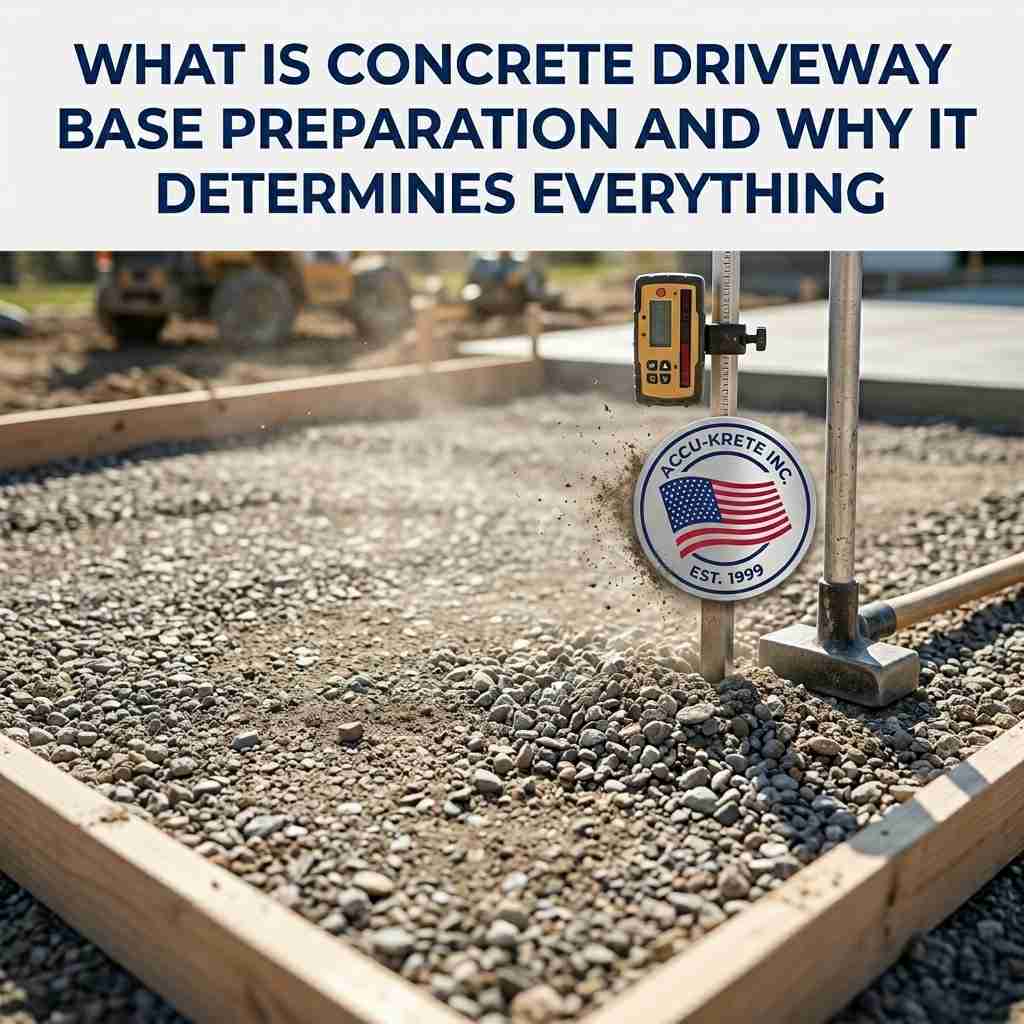
Many property owners think of concrete as if it were a self-supporting bridge. They assume its rock-hard surface makes it completely immune to whatever is happening in the ground underneath. In reality, a concrete slab works more like a stiff outer shell. It cannot stretch or bend without breaking due to its low tensile strength, which makes it fully dependent on the smoothness and strength of the foundation below. Proper concrete driveway base preparation is the engineered process of clearing, grading, and packing down the ground so it can carry heavy vehicle weight evenly.
Putting time and money into careful base preparation is what separates a driveway that lasts 30 years from one that falls apart in less than five. The preparation process involves fixing weak native soil, controlling trapped moisture, and building a rock-solid platform that matches the demands of the vehicles using it. Skipping steps during this phase is a serious gamble that steel reinforcement simply cannot save you from. If the base shifts, sinks, or washes away, the concrete on top will follow, leading to costly repair bills or a complete demolition.
Why the Subgrade Is the Most Critical Part of Your Driveway
The subgrade — which is the natural native soil on your property — is what ultimately holds the entire weight of the driveway and your vehicles. Concrete spreads weight across a wide area, but if the soil underneath is unevenly packed or has soft spots, the slab will flex under pressure. Because concrete handles direct downward pressure very well but breaks easily when it bends, this flexing causes structural cracks to form right away.
Engineers treat the subgrade as the actual foundation of the driveway. If it fails, everything above it fails too. The most important part of preparing the subgrade is getting it packed as tightly as possible using heavy machinery. Loose, uncompacted dirt is full of air pockets and rotting plant matter that gradually compress under the weight of daily traffic. On top of that, a poorly prepared subgrade lets water collect right underneath the slab, which causes the dirt to wash away or leads to violent shifting during freezing weather that destroys the concrete from below.
The Core Components of a Concrete Driveway Base
A durable driveway foundation is a smart, multi-layered system built to handle heavy loads and manage moisture effectively. Each layer has a specific job to do, turning unpredictable ground into a stable and highly supportive platform.
Subgrade (The Native Soil)
The subgrade is the very bottom layer, made up of natural ground that has been cleared of grass, weeds, dark topsoil, and roots. Before any gravel is added, this native soil must be shaped to match the final slope of the driveway and packed down thoroughly using a heavy mechanical plate compactor or roller.
The biggest challenge with subgrade preparation is dealing with different soil types:
- Coarse-Grained Soils (Sand and Gravel): These are great for drainage and weight-bearing, and they need very little work beyond basic compaction.
- Fine-Grained Soils (Clay and Silt): These are highly problematic. Clay swells when wet and shrinks when dry, creating a constant movement cycle that snaps concrete over time.
- To stabilize poor subgrade soil, sticky clay or weak silt often needs gravel mixed into it, or chemical stabilizers like lime or cement added to stop it from reacting to moisture before any work moves forward.
Subbase (The Aggregate Layer)
The subbase sits directly on top of the native soil and acts as the main weight-spreading layer. Usually made of 4 to 6 inches of crushed angular stone, open-graded gravel, or recycled concrete, this layer serves two important engineering purposes: it stops water from rising up to the slab, and it acts as a tough cushion that smooths out minor imperfections in the dirt below.
Using crushed stone with sharp, angular edges is important because the jagged shapes lock tightly together when compacted, creating a firm and rigid platform. Round or smooth stones will roll and slide under pressure, causing the concrete above to crack. A properly packed gravel base ensures even support, separates the concrete from shifting dirt, and gives water a clear path to drain away safely.
Step-by-Step: Professional Concrete Base Is Prepared
Building a structurally sound concrete driveway requires following strict professional steps in the right order. Skipping or rushing any of these stages directly weakens the load-bearing strength of the final slab, causing it to break down early under vehicle traffic.
Step 1: Site Clearing and Deep Soil Excavation
The preparation begins by clearing the entire driveway area of all grass, weeds, large tree roots, and dark topsoil. Topsoil contains organic matter that rots over time, leaving hidden empty holes underground that will cause a driveway to collapse under heavy weight.
Professionals dig down until they reach stable, inorganic native subgrade soil, which usually means excavating 8 to 12 inches below the final planned driveway surface. This depth leaves the right amount of room for both the packed gravel subbase layer, usually 4 to 6 inches, and the final concrete slab itself, which needs a minimum of 4 to 6 inches depending on how heavy your vehicles are.
Step 2: Mechanical Subgrade Compaction
Once the raw native soil is exposed and shaped to the right level, it must be mechanically packed down to squeeze out air pockets and increase soil density. Pouring expensive gravel or concrete over loose, uncompacted dirt is a guaranteed way to end up with uneven settling and deep structural cracks.
Contractors use commercial-grade vibratory plate compactors or heavy rollers to pack the native soil until it reaches at least 95% maximum dry density. If the native dirt is too dry and powdery, they lightly spray it with water to reach the right moisture level, which helps soil particles slide and lock together into a tight, solid foundation.
Step 3: Selecting the Right Base Material
Choosing the right gravel material means looking at how well your native soil drains and how much it shifts. A well-graded road base containing a precise mix of angular rocks and fine stone dust is the industry standard for normal, stable ground because it packs down into a dense, hard mat. However, for properties sitting on highly expansive clay or in low-lying areas with a high water table, clean washed, angular stone is chosen to prioritize fast water movement away from the slab.
To make the selection process simpler, contractors focus on three main material options:
- Road Base: A mix of 3/4-inch stone down to fine rock dust. It packs into an extremely dense, hard foundation that offers maximum weight distribution for normal, well-draining soils.
- Clean Stone: Washed angular stones with no dust or sand. It leaves permanent air gaps that allow water to drain instantly, making it the right choice for heavy clay or freeze-thaw climates.
- Recycled Concrete: Crushed old concrete that works as a budget-friendly, eco-friendly alternative. It locks together very well and hardens over time to create a highly durable base layer.
Step 4: Laying and Grading the Aggregate Base
The selected gravel must be spread evenly across the packed dirt in controlled layers, called lifts, that are no deeper than 4 inches at a time. Trying to compact a single 6-inch layer of gravel all at once results in poor density at the bottom, leaving hidden weak points.
Each layer is carefully measured and shaped using transit levels to match the final planned pitch of the driveway, creating a slope of at least 1/4 inch of drop per linear foot so rainwater runs away from buildings. The vibratory compactor is run over the gravel multiple times until the stones lock tightly together, forming a smooth, flat, firm platform that shows no tire ruts when heavy machinery drives across it.
Step 5: Integrating Geotextile Fabric and Reinforcement
On challenging job sites with soft silt or expansive clay soils, a heavy-duty woven geotextile fabric is rolled out directly over the raw dirt before any gravel is added. This engineered fabric acts as a vital separation barrier, stopping the clean gravel from gradually sinking into the soft mud under the constant pounding of traffic. Once the aggregate subbase is fully packed on top of the fabric, the structural reinforcement grid is built. Heavy steel rebar grids or thick welded wire mesh are laid out and spaced at 16 to 18-inch intervals.
To get the best structural reinforcement, contractors focus on these key components:
- Geotextile Underlayment: A heavy-duty woven fabric that stabilizes soft ground. It keeps the gravel base from mixing with native mud while still allowing water to drain through freely.
- Steel Rebar Grid (#3 or #4): Heavy iron bars tied together with wire at 16 to 18-inch intervals. Rebar provides tensile strength, holding the concrete together and stopping cracks from opening up under heavy vehicle loads.
- Welded Wire Mesh: A lighter, grid-like alternative to rebar made of connected steel wires. It provides good resistance against minor surface shrinkage and temperature-related cracks throughout the slab.
- Support Chairs or Bricks: Specialized plastic or concrete blocks used to lift the steel grid off the gravel base. This keeps the metal perfectly centered inside the concrete during the pour, rather than sinking to the bottom, where it would be structurally useless.
Prepare a Correct Base for Concrete Driveways
A concrete driveway is only as strong as the ground beneath it. Skipping steps or rushing through subgrade and subbase preparation guarantees structural failure—leading to cracking, sinking, and shifting under vehicle weight. Pouring expensive concrete over a poorly prepared foundation is a waste of time and money. To build a driveway that lasts for decades, you must execute a systematic, highly engineered preparation process that ensures uniform support and flawless drainage.
Step-by-Step Concrete Driveway Base Preparation
| Phase | Action Item | Critical Technical Specifications | Why It Matters / What Happens If You Skip It |
| 1. Site Clearing | Excavation & Topsoil Removal | Remove all grass, roots, debris, and organic topsoil. Excavate to a depth of 7 to 8 inches (allowing for a 4-inch base and 4-inch concrete slab). | Organic matter decomposes over time, creating hollow voids under the driveway that cause the concrete to crack and collapse under heavy loads. |
| 2. Subgrade Subsoil Stabilization | Soil Assessment & Mechanical Compaction | Compact the native subsoil using a heavy-duty vibratory plate compactor or roller until it reaches 95% proctor density. Moisture content must be optimal (damp, not muddy). | Weak or uncompacted native soil shifts under vehicular traffic. Uniform compaction prevents differential settlement, which is the primary cause of major structural cracks. |
| 3. Subbase Material Selection | Aggregate Sourcing | Use 4 inches of crushed angular stone (e.g., 3/4-inch crushed gravel with fines / road base). Avoid rounded river rock or uniform clean stone. | Angular stones interlock mechanically under pressure, creating a rigid, unyielding platform. Rounded stones roll and shift, destabilizing the concrete overlay. |
| 4. Subbase Layering & Compaction | Gradual Compaction Technique | Run the plate compactor over the aggregate base in multiple passes. Lightly mist the gravel with water during compaction to lock the fine particles into the voids. | Proper compaction of the aggregate eliminates remaining air pockets, ensuring the base can support heavy trucks without shifting or rutting. |
| 5. Grading & Drainage Setup | Pitch Determination | Establish a minimum slope of 1/4 inch per linear foot away from the home garage and foundation. | Standing water pooling beneath or beside a driveway weakens the base and causes severe cracking during freeze-thaw cycles. Water must flow away instantly. |
| 6. Reinforcement Placement | Vapor Barrier & Rebar/Mesh | Install a heavy-duty vapor barrier (if moisture control is needed) and lay down a grid of #3 (3/8-inch) rebar spaced 16 inches apart, elevated on concrete chairs. | Rebar must sit in the middle of the concrete slab, not at the bottom. Proper placement holds the concrete tight and prevents cracks from widening. |
What Happens If You Skip Base Preparation? (Sinking, Cracking, Scaling)
Cutting corners or skipping the base preparation phase causes severe, permanent damage to residential concrete driveways. Concrete can handle enormous direct downward weight, but it has very low tensile strength and cannot bend without snapping.
- Sinking and Settling: When heavy vehicles park on a slab poured over uncompacted soil, the earth underneath slowly compresses as air is forced out of the loose dirt. This creates large underground gaps, causing big sections of the concrete driveway to sink out of alignment, tilt, or drop several inches below the garage floor or nearby sidewalk.
- Structural Cracking: As sections of the underlying base wash away or sink, the concrete slab is forced to span over empty air pockets below it. Because concrete cannot bend, the moment a heavy truck or SUV drives over these unsupported hollow areas, the slab snaps instantly under the pressure, resulting in deep, jagged settlement cracks that cannot be permanently patched or repaired.
- Scaling and Freeze-Thaw Damage: A base built without proper drainage gravel traps rainwater directly against the bottom of the concrete slab. In cold climates, this trapped moisture freezes and expands by about 9% in volume, creating strong upward pressure that pushes against the concrete. This repeated freezing forces water into the tiny pores of the slab, causing scaling — a damaging process where the smooth top surface of the driveway constantly flakes, pits, and breaks off, eventually turning into loose gravel.
Conclusion
The lifespan of a residential concrete driveway is decided entirely before the mixer truck ever arrives on site. Property owners often focus on the visual finish or thickness of the concrete slab, but the foundation layers underneath are what truly bear the weight of daily traffic. Skimping on soil compaction, skipping the gravel subbase, or leaving out structural steel will seriously compromise the project, turning a major financial investment into a web of deep, unfixable cracks within just a few seasons.
Executing a solid base preparation strategy requires following technical standards closely, evaluating the soil properly, and managing slope carefully for moisture control. By treating the native soil and gravel base as one connected structural system, contractors build an unyielding platform that stops soil movement and prevents destructive water buildup. Investing the necessary time, labor, and correct materials into this initial phase ensures the concrete surface stays perfectly level, highly resilient, and structurally sound for decades to come.
Frequently Asked Questions
What is the minimum recommended thickness for a concrete driveway base?
A professional installation typically requires a gravel subbase thickness of 4 to 6 inches over a fully compacted native soil foundation. This depth provides the necessary weight distribution and drainage separation needed to support passenger cars and light trucks.
Why is a plate compactor necessary for subgrade preparation?
Loose soil contains air pockets and rotting plant matter that naturally compress under the weight of heavy vehicles. A mechanical plate compactor forces these loose soil particles tightly together to reach a minimum of 95% maximum dry density, preventing future sinking and slab settling.
Can concrete be poured directly onto sandy native soil without an aggregate base?
Sandy soils offer naturally good drainage and weight-bearing capacity, meaning a separate gravel subbase layer is sometimes skipped if the sand is pure and deep. However, the sandy soil must still be thoroughly cleared of organic matter, graded for proper drainage, and mechanically compacted to full density before the pour.
How does clay soil damage a newly installed concrete driveway?
Clay is a highly expansive, fine-grained soil that absorbs water and swells during wet seasons, then shrinks and cracks when it dries out. This constant movement creates underground shifting beneath the concrete, putting enormous bending stress on the rigid slab above until it eventually cracks.
What is the exact structural purpose of rebar chairs during a concrete pour?
Steel rebar only provides bending strength when it stays embedded within the middle section of the cured concrete slab’s total thickness. Metal or plastic support chairs lift the steel grid off the gravel subbase, preventing the reinforcement from sinking to the bottom of the wet concrete, where it becomes structurally useless.
When should a geotextile fabric layer be installed under the driveway base?
Geotextile fabric is strongly recommended when installing a driveway over soft silt, saturated ground, or heavy clay soils. The woven fabric acts as a permanent separation barrier that keeps the clean gravel base from sinking down and mixing with the soft native mud over time.
Professional Concrete Services in Orlando, FL
Accu-Krete provides reliable concrete installation, repair, decorative concrete, patios, driveways, and sidewalk solutions for homeowners and businesses across Orlando and nearby areas.