
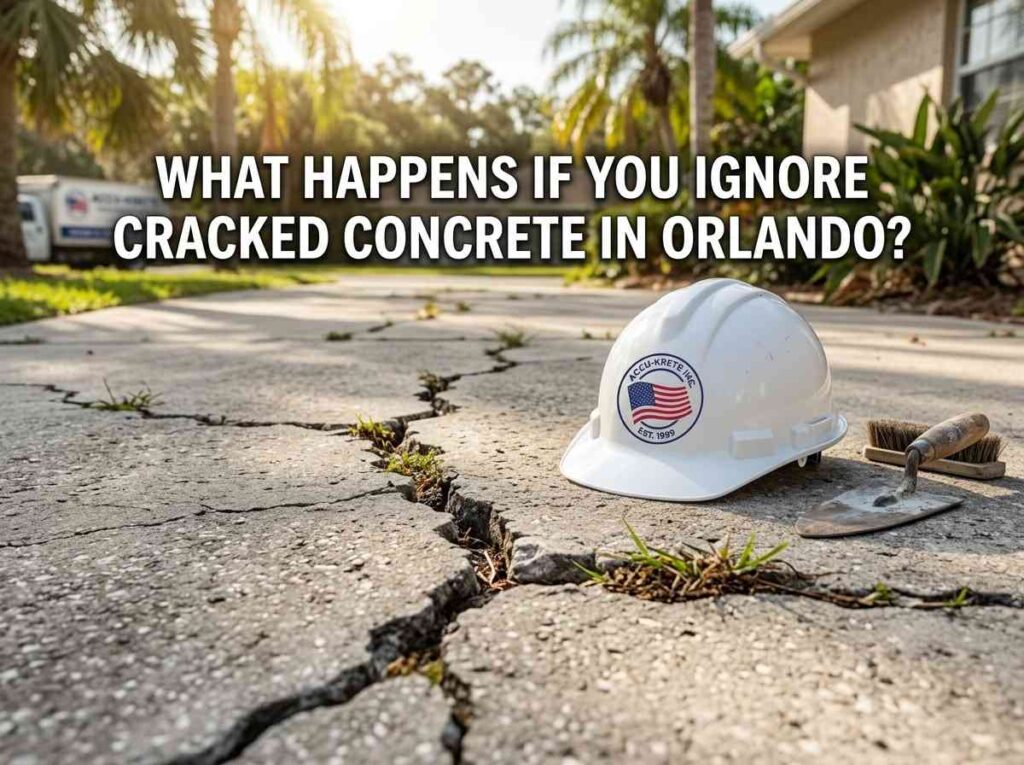
That hairline fracture on your driveway or pool deck isn’t just an eyesore; it is a ticking financial time bomb. Homeowners in the Sunshine State frequently dismiss minor concrete cracking as a cosmetic issue, completely ignoring the volatile subterranean shifts and aggressive weather patterns unique to Central Florida. Ignoring these fractures allows daily torrential downpours and shifting sandy soils to actively undermine the structural integrity of your entire property.
The cost of procrastination is exceptionally high, transforming simple maintenance into catastrophic foundation or hardscape collapse. As water relentlessly seeps into unsealed gaps, it erodes the stabilizing base beneath the slab, creating hidden voids that invite sudden sinkhole activity or severe tropical storm damage. Furthermore, unchecked cracking completely decimates your property’s market value, rendering it a massive liability during mandatory real estate inspections.
Understanding Why Concrete Cracks
Concrete may appear indestructible, but it is fundamentally a rigid material susceptible to immense environmental and structural pressures. The primary catalyst for initial cracking is drying shrinkage, which occurs as excess water evaporates during the curing process, causing the material to contract and split under tensile stress.
When you ignore these early, microscopic fissures, you open the floodgates for Central Florida’s extreme climate to accelerate the destruction. Localized shifting, heavy vehicular loads, and poor initial installation practices all compound this vulnerability, ensuring that small fissures rapidly widen into major structural hazards.
Central Florida’s Volatile Subgrade and Soil Erosion
The sandy soil profile of provides exceptionally poor structural stability, shifting violently under the influence of fluctuating water tables. Heavy seasonal rains wash away the fine sand particles directly beneath your concrete slabs, leaving behind hollow voids that cannot support the weight above. Without a solid, uniform base, the unsupported concrete bends under its own weight and snaps under the pressure.
The Impact of Intense Heat and Thermal Expansion
Orlando’s relentless summer heat forces concrete to expand significantly during the day, followed by a period of contraction as temperatures cool at night. This continuous cycle of thermal expansion and contraction exerts massive internal pressure on the slab, especially if proper expansion joints were omitted during construction. The resulting stress inevitably forces the concrete to fracture at its weakest points to relieve the pressure.
Invasive Root Systems from Subtropical Vegetation
The rapid growth of aggressive subtropical trees, such as live oaks and palms, poses a direct threat to nearby concrete installations. As these powerful root systems expand in search of moisture, they exert immense upward pressure on driveways, sidewalks, and patios. This localized lifting creates severe, uneven cracking and dangerous tripping hazards that cannot be resolved without addressing the root growth beneath.
Why Does Concrete Crack in the First Place?
At its core, concrete cracks because its tensile strength is remarkably low compared to its immense compressive strength. Property owners often fail to realize that concrete is a dynamic material that reacts constantly to its surrounding environment and chemical composition. Mismanaged water-to-cement ratios during the mixing phase create a fundamentally weak matrix that is highly prone to fracturing under the slightest external stress.
When external environmental forces act upon an inherently flawed or unprotected mix, the structural bonds fail, initiating a chain reaction of degradation.
Poor Initial Mixing and Excessive Water Content
Contractors frequently add excess water to concrete mixes on-site to make the material easier and faster to pour and finish. While this speeds up labor, the surplus water weakens the chemical bonds of the cement matrix and leaves behind microscopic voids as it evaporates. This porous, low-density concrete lacks the structural integrity required to withstand standard weight loads, leading to premature and widespread fracturing.
Inadequate or Missing Control Joints
Control joints are intentional, pre-cut grooves placed in concrete to predetermine where the slab will crack as it shrinks and moves. When a contractor spaces these joints too far apart, cuts them too shallow, or omits them entirely, the concrete will create its own jagged, unmanaged fractures. These random cracks compromise the slab’s load distribution and look vastly worse than a clean, engineered joint line.
Can Cracked Concrete Be Fixed?
The short answer is yes, but the efficacy of the repair depends entirely on your speed of intervention and the specific repair method chosen. Minor cosmetic cracks can often be resolved with high-grade polyurethane or epoxy injections that seal the breach against moisture intrusion. However, simply slapping a topical sealant over a structural crack caused by a sinking foundation or massive void is a useless, temporary fix.
Professional structural assessments are mandatory to determine whether your concrete requires simple sealing, advanced polyurethane foam lifting, or a total, uncompromised replacement.
- Polyurethane Foam Injection (Slabjacking): A highly effective, modern technique where a dense foam is injected beneath a sunken slab to fill voids, stabilize the underlying sandy soil, and lift the concrete back to its original level.
- Epoxy and Polyurea Crack Sealing: Heavy-duty, flexible chemical sealants are injected deep into non-structural cracks to completely block water penetration and prevent further moisture-driven erosion.
- Concrete Resurfacing: A cosmetic and protective option where a thin, polymer-modified cement layer is applied over properly prepared, stable concrete to erase surface blemishes and restore a uniform finish.
- Complete Demolition and Re-pour: The unavoidable, costly final resort required when the structural integrity of the slab is entirely compromised, the reinforcement steel has rusted away, or the subgrade failure is too severe for localized lifting.
Why Small Cracks Can Become Big Problems
A hairline fracture in a concrete slab acts as an open invitation for progressive environmental and structural destruction. In regions like Orlando, daily afternoon downpours force high volumes of water directly into these narrow openings, initiating a rapid cycle of subterranean erosion. As the water passes through the crack, it carries away the fine sand and soil particles that constitute the slab’s critical supporting base.
This continuous washaway effect creates hidden, empty pockets beneath the heavy concrete, completely removing its structural support. Without a solid foundation underneath, the rigid slab is forced to bridge these growing voids entirely on its own strength.
How to Assess Concrete Cracks
Evaluating the severity of a concrete crack requires looking beyond the surface to identify the underlying mechanical failure. Property owners must analyze the width, direction, and structural orientation of the fissure to determine if it is a minor shrinkage issue or a major foundational threat.
Cracks that are completely flat and measure under one-eighth of an inch wide generally point to standard drying shrinkage or minor settling. Conversely, fractures that display vertical displacement—where one side of the crack is noticeably higher than the other—indicate a severe subgrade failure.
Ignoring these distinct visual indicators allows minor, easily repairable surface issues to secretly mature into unfixable structural collapses.
Hairline and Surface-Level Fractures
Surface-level cracks are thin, shallow splits that typically develop within the first few weeks of the concrete pouring process. These fractures are usually non-structural and do not immediately threaten the stability of the entire concrete installation. However, they must still be cleaned and sealed promptly to prevent water from entering and deepening the breach over time.
Displaced and Vertical Settling Cracks
Displaced cracks occur when the concrete on one side of the fracture sinks lower than the adjacent section due to base failure. These cracks create uneven surfaces, major tripping hazards, and indicate that the underlying soil has washed away completely. They cannot be fixed with simple sealants and require professional leveling techniques to restore the structural plane.
Deep Structural and Foundational Fractures
Structural fractures are wide, deep splits that cut entirely through the thickness of the concrete slab, often extending into the foundation. These cracks compromise the load-bearing capacity of the material, making the structure highly unstable under heavy weights or high winds. They require immediate evaluation by a structural engineer to implement deep reinforcement or comprehensive underpinning solutions.
Key Consequences of Ignoring Concrete Cracks
Neglecting visible concrete damage triggers a destructive chain reaction that rapidly diminishes both the safety and financial value of your property. As water infiltrates the unsealed openings, it inevitably reaches the internal steel rebar or wire mesh embedded within the slab for tensile strength. Exposed to moisture and oxygen, this structural steel oxidizes and rusts, expanding up to eight times its original volume.
This internal expansion exerts immense outward pressure on the surrounding concrete, a destructive process known as spalling that pops the surface layer right off. Beyond structural failure, jagged, uneven cracks turn your walkways and driveways into severe, high-liability tripping hazards for visitors and residents alike.
Rapid Acceleration of Subbase Erosion
When water flows completely unchecked through open cracks, it continuously carves out the critical soil base directly beneath the heavy slab. This unmanaged erosion creates expanding subterranean voids that leave the heavy concrete completely unsupported from below. Without immediate intervention, the slab will cave into the empty pocket under the weight of standard vehicular traffic.
Destructive Corrosion of Internal Steel Reinforcement
Moisture penetration directly causes the internal steel rebar to rust, corrode, and lose its structural bonding capabilities with the concrete matrix. As the rusting steel expands, it cracks the concrete from the inside out, leading to severe surface breaking and crumbling. This internal decay permanently destroys the load-bearing capacity of the entire hardscape installation.
Immediate Devaluation of Property and Curb Appeal
Visible, jagged cracks across highly prominent areas like driveways and entryways create an immediate impression of poor maintenance and property neglect. Real estate appraisers and home inspectors mark these cracks as significant liabilities, forcing steep price reductions during property sales. Proactive repair is far more cost-effective than absorbing the massive financial loss of a degraded property value.
How to Prevent Cracks in Concrete
Preventing fractures in your concrete requires strict adherence to proper engineering principles right from the initial planning phase. Slabs that are poured without careful preparation are fundamentally designed to fail under environmental and structural pressure. By proactively addressing soil stability, mix density, and curing times, you eliminate the underlying stressors that force concrete to split.
Investing time and resources into correct installation techniques is significantly cheaper than dealing with ongoing structural repairs down the road. Ultimately, a highly disciplined approach to the pouring process guarantees a durable, long-lasting surface that can withstand heavy loads and harsh weather.
1. Use the Right Mix
Achieving the correct water-to-cement ratio is absolutely paramount to producing high-strength, crack-resistant concrete. Adding excess water on-site weakens the chemical paste, leaving behind highly porous structures as the surplus moisture eventually evaporates. Utilizing a professional-grade mix with a low water content ensures maximum density and load resistance.
2. Prep the Base Properly
A concrete slab is only as stable and reliable as the ground material directly supporting it from below. The subgrade must be thoroughly cleared of organic debris, completely leveled, and mechanically compacted to eliminate future settling risks. Incorporating a solid layer of crushed stone improves drainage and prevents local soils from shifting or washing away.
3. Install Control Joints
Control joints are highly strategic, pre-engineered cuts placed in the slab to neatly dictate exactly where the concrete will crack as it shrinks. These joints must be cut to a depth of at least one-quarter of the total slab thickness to be effective. Proper spacing ensures that natural contraction stress is relieved without creating ugly, unmanaged surface splits.
4. Cure the Concrete Correctly
Curing is the vital process of maintaining adequate moisture and temperature levels within the concrete during its early hydration phase. Slabs that dry out too quickly lack the necessary moisture to complete the chemical bonding process, resulting in a fragile surface. Utilizing curing compounds or continuous misting for several days maximizes the concrete’s ultimate tensile strength.
5. Plan for the Load
Concrete installations must be engineered from the start to handle the specific weight demands of their intended application. Driveways meant for heavy trucks require thicker pours and heavier steel reinforcement than standard residential backyard patios. Properly anticipating these weight loads prevents the finished slab from bending, snapping, and fracturing under daily mechanical pressure.
Conclusion
Ignoring cracked concrete in Orlando is an expensive gamble against Florida’s unforgiving climate and unstable sandy soils. What begins as a minor, hairline fracture will steadily evolve into a severe structural hazard as daily downpours erode the underlying subbase. Proactive intervention—whether through professional slabjacking, timely crack sealing, or foundational stabilization—safeguards your property value and eliminates dangerous liability risks.
Investing in timely concrete restoration is a strategic financial decision that protects your entire property investment from catastrophic failure. Delaying repairs only guarantees that future remediation efforts will require total, high-cost demolition and a complete slab replacement. By partnering with local structural experts to assess, repair, and reinforce your concrete, you maintain an authoritative, pristine, and secure environment.
FAQS
Why does concrete crack in Florida?
Concrete in Florida cracks primarily due to heavy tropical downpours eroding the weak sandy subgrade, combined with intense heat causing severe thermal expansion and contraction. This environmental stress is further aggravated by a volatile, shifting water table and aggressive subtropical root systems.
Who is responsible for cracked concrete?
Determining liability depends entirely on timing; contractors are responsible if the cracks stem from poor mixing or improper installation during the warranty period, while property owners bear the responsibility if the damage occurs years later due to natural shifting, tree roots, or general neglect.
How big of a crack is acceptable in concrete?
Hairline fractures measuring less than one-eighth of an inch wide are generally considered acceptable cosmetic occurrences caused by standard drying shrinkage. Any split exceeding this threshold, or displaying vertical displacement where one side is higher than the other, indicates a structural failure that requires immediate intervention.
What happens if you don’t cut concrete within 24 hours?
Failing to cut control joints into green concrete within the critical 24-hour window allows internal tensile stress to build rapidly as the slab shrinks. Consequently, the concrete will relieve this pressure by creating its own jagged, unmanaged, and structurally weak fractures across the surface.
When to worry about concrete cracks?
You must worry about concrete cracks the moment they exhibit vertical shifting, widen beyond one-eighth of an inch, or continuously grow in length. These specific structural warning signs indicate active foundation movement, severe subbase failure, or compromised internal steel reinforcement.
How much does it cost to repair a cracked concrete floor?
Repairing a cracked concrete floor typically ranges from $250 to $800 for minor epoxy or polyurethane crack injections, while advanced structural leveling or slabjacking can cost between $900 and $3,000. If the structural degradation is severe enough to require complete demolition and a new pour, costs escalate significantly to $5 to $15 per square foot.
Professional Concrete Services in Orlando, FL
Accu-Krete provides reliable concrete installation, repair, decorative concrete, patios, driveways, and sidewalk solutions for homeowners and businesses across Orlando and nearby areas.